
How to put together a craft beer pack without making a mistake?

You're looking at the catalog, 30 available references, and you end up clicking on 12 IPAs because that's what you know. The result: a monochromatic evening where bitterness turns into taste fatigue by the fourth bottle.
Composing a craft beer pack is a rare opportunity to create true sensory progression. But it requires a method, not just intuition.
IBU doesn't tell the whole story
Classic reflex: sorting beers by IBU, thinking that the lower the number, the more accessible it is. The problem is that IBU measures the concentration of hop alpha acids, not what you feel in your mouth. The overall flavor profile, the sugar-bitterness balance, and the volatile hop compounds influence the final experience more than the raw number.
Concretely, a well-balanced 60 IBU IPA with its malts can seem smoother than a poorly constructed 40 IBU Pale Ale. Hence the importance of always cross-referencing IBU with the style before validating your choice.
Standard ranges by style remain a good starting point: Wheat between 8 and 20 IBU, Pale Ale between 30 and 50, IPA between 40 and 70, Stout between 30 and 60. These ranges align with the BJCP guidelines, the international reference for beer style classification. Use these benchmarks to make an initial selection, then refine with the beer's description. To go further, the article on bitterness in beer beyond IBU breaks it all down in detail.
Aim for 4 to 6 different styles for 12 bottles
Diversity is the strength of a pack, but too many styles kill readability. For a pack of 12, the right benchmark is between 4 and 6 distinct styles. Not 12 identical bottles that bore you, nor 12 different styles that overwhelm you.
To proportion, our suggestion: about 4 bottles of styles you know well, 4 you've already encountered once, and 4 completely new. This is a starting point that avoids both boredom and sensory overload, to be adjusted according to your current curiosity.
A detail that changes everything: include a reference beer in your pack, meaning a beer you know perfectly and that serves as a calibration point. The idea is simple: between two discoveries, returning to a familiar profile allows you to reset your taste buds and better perceive contrasts. For us, Zepp' often plays this role: its clean, floral lager profile recenters the senses between two discoveries. Without this reference, flavors blend and you lose perception finesse from the fifth bottle onwards.
Structure your pack by increasing intensity
Reasoning by style family is intuitive but tricky. A more effective approach: categorize by intensity level, from mildest to most intense, regardless of style.
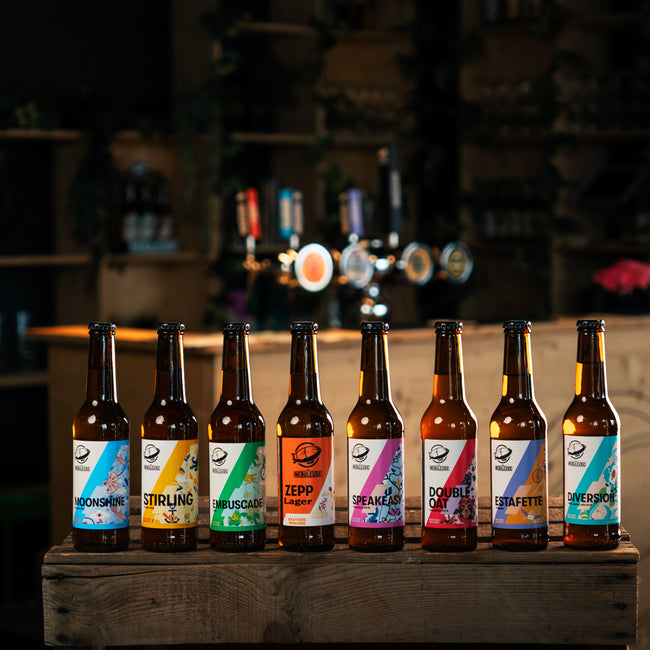
Mild tier (IBU 8-30): Wheat, Lager, Session IPA, Hoppy Lager. These are accessible and refreshing profiles, those that open the ball without overwhelming the taste buds. Hoppy Lagers, moreover, make an excellent bridge between mainstream and craft for beginners. A Moonshine or a Speakeasy are typically ideal entry bottles in this tier.
Balanced tier (IBU 30-50): Pale Ale, NEIPA, Amber Ale. This is the pivot of the pack, the benchmark style. This is where preferences are formed, as the malt-hop balance is most readable here. To grasp the difference between a juicy NEIPA and a dry West Coast, this tier is the ideal ground.
Intense tier (IBU 50+): West Coast IPA, Double IPA, Stout, Sour. Marked and polarizing profiles that beautifully conclude the tasting. Stouts and Porters bring a roasted dimension that contrasts with everything that precedes.
For an initiation pack, we suggest leaning towards 4 mild, 5 balanced, and 3 intense beers. For an amateur pack, reverse the balance: 2 mild, 4 balanced, 6 intense. These are not set rules, but rather benchmarks we use internally that work well. In both cases, the balanced tier remains the foundation.
Adapt the composition to the occasion
The best intensity grid in the world is useless if it ignores the context. A pack for a casual aperitif is not composed like a discovery gift.
- Aperitif with friends: lean towards the mild and balanced tiers. Avoid polarizing profiles like heavy Stouts or 8% Double IPAs that suppress appetite. For specific ideas, the guide to craft beers for a successful aperitif guides you to the right styles.
- Discovery gift: maximize style diversity. Include a Session IPA or a Wheat as an entry bottle, and avoid strong beers if you don't know the recipient's tastes. Wheat beers and Lagers are safe bets for remaining neutral.
- Serious tasting: structure an IBU progression conscious from start to finish, and include at least two styles the recipient has never tasted. This is where the pack truly comes into its own. The style sheets available online allow you to check the expected characteristics of each beer before composing your selection.
Ultimately, the occasion dictates the proportions between the three tiers. Keep the increasing intensity structure as a backbone, and simply adjust the balance between accessibility and exploration according to the context.
Three rules to no longer compose at random
Three rules to remember: IBU is a starting filter always cross-referenced with the style, 4 to 6 styles for 12 bottles with a mix of familiar and discovery, and a structure by increasing intensity that avoids abrupt breaks.
The easiest way to put all this into practice is to compose your pack directly on the e-shop: 12 or 24 33cl bottles, you choose each reference, and delivery is free for orders over CHF 100. If you want to taste before you commit, the brewery offers visits with tasting in Renens, the perfect opportunity to identify your future anchor beers.
Cheers! 🍻


