

Lager or ale, the real difference lies in the yeast
A lager can be as dark as ink. An ale can be blonde and clear. Color tells us nothing about a beer's family, and alcohol content even less. Yet, these are often the only reference points we use when facing the craft beer aisle, choosing between an IPA, a pilsner, a stout, and a saison. The result: we pick randomly or rely on misleading clues.
The real difference between lager and ale lies where no one looks, in a microscopic ingredient. Understand this single criterion, and you'll never confuse a lager and an ale again, guaranteed.
Yeast decides, not color or alcohol content
Immediately forget three false leads. Color doesn't classify a beer, nor does alcohol, and geographic origin even less. The only criterion that truly structures everything is the type of yeast and the temperature at which it works.
There are two main families of brewing yeasts. For ales, we use strains of Saccharomyces cerevisiae, the same family as bread and wine yeasts. For lagers, it's Saccharomyces pastorianus, a yeast with very different behavior. These two microorganisms don't ferment under the same conditions, and that's where everything else stems from.
The most concrete difference is temperature. Ale yeasts thrive in a temperate zone, between 15 and 25°C, roughly the temperature of a slightly warm cellar. Lager yeasts, on the other hand, prefer the cold, between 6 and 14°C, which is close to refrigerator temperatures. This temperature constraint is not a minor detail: it's what shapes the final taste of your beer.
Concretely, when you drink a pilsner, a Helles, or a Bock, you're drinking a lager. When you open a white beer, a stout, or an IPA, you're holding an ale. This is the reference point that replaces color and alcohol, once and for all. We explain the rest in our article on the great beer styles.
Top or bottom fermentation, what yeast really does
You've probably come across the terms "top fermentation" for ales and "bottom fermentation" for lagers. They simply describe where the yeast positions itself in the tank during its work.
Ale yeast rises, lager yeast stays at the bottom
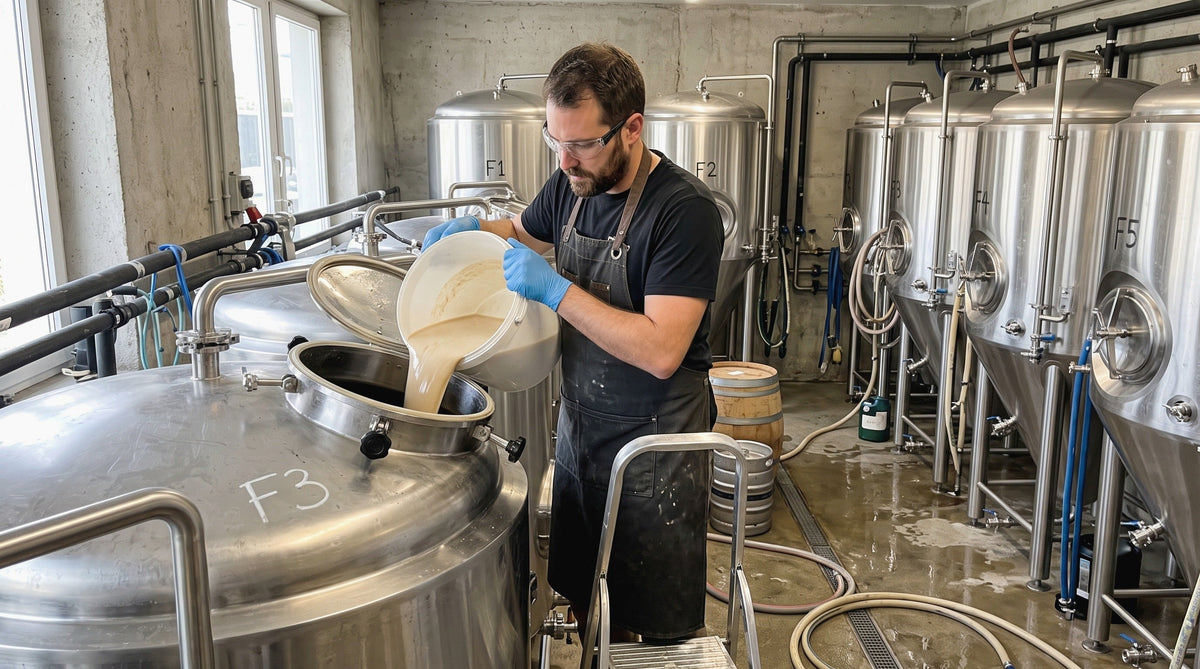
Saccharomyces cerevisiae yeast has a surface that repels water. As a result, its clumps attach to CO2 bubbles and rise to the surface of the wort. You literally see it floating at the top of the tank, hence the name top fermentation.
Lager yeast does the opposite. It works deep down, in the cold, and settles at the bottom of the tank. This is bottom fermentation. But be careful of the key nuance: this position is only a visible consequence, not the primary cause.
What matters is the physiology of the yeast, its cold tolerance, and its way of digesting sugars. Its position in the tank is only the result we observe with our eyes.
Why you can't just cool down an ale yeast
One might think that all it takes to get a lager is to put an ale yeast in the cold. It doesn't work. An ale strain functions poorly below about 12°C, whereas a lager strain remains very active down to at least 7°C. Each yeast has its comfort zone, and you can't force it without breaking the fermentation.
Another misconception to correct: lager is not slower to ferment. The fermentation itself can be fast, even at cold temperatures. What lengthens the process is lagering, this long maturation at low temperatures. The word "lager" comes from the German lagern, which means to store. It's all in the name.
A genetic hybrid born from Bavarian cold
Here's the fact almost no one tells. Lager yeast isn't just an ale yeast that learned to resist the cold. It's a hybrid organism, born from the crossing of two different yeast species.
Saccharomyces pastorianus is the result of the union between a classic ale yeast and a cold-tolerant wild yeast. Two yeasts that joined forces to survive harsh winters. This hybridization gives it its superpower: fermenting in the cold where its ale cousin gives up.
The story is Bavarian. As early as the 16th century, regulations governed brewing, and Bavarian dark beer was then brewed with bottom-fermenting yeasts, favored by the cold climate of cellars. It wasn't until the late 19th century that the scientist Emil Christian Hansen isolated the first pure strain, at Carlsberg in Copenhagen.
And the taste in all this? The cold slows down the yeast's metabolism, which then produces fewer secondary aromatic compounds like esters, those molecules responsible for fruity and floral aromas. That's why lagers, which today represent nearly 90% of the world market, have this "clean" and crisp profile. Conversely, an ale expresses more frank and expressive aromas, the fruit of a warmer fermentation.
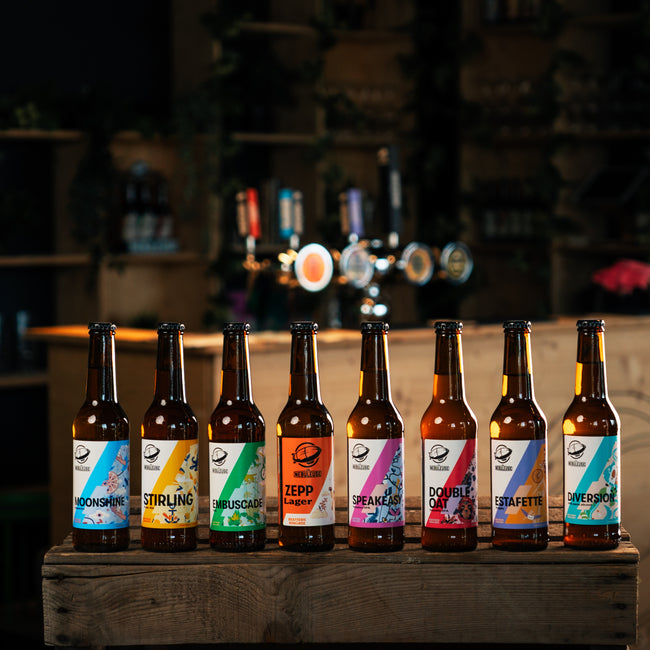
Here, our Zepp perfectly illustrates this family of craft lagers, a style we have also dissected in detail. But the line isn't always clear: our Beer des Rosses FWT is an India Pale Lager, a hopped beer in the IPA style that nevertheless uses lager yeast. Proof that the craft beer aisle likes to blur the lines.
Remember three things and you won't go wrong again. Yeast is the real criterion, not color or alcohol. The yeast's position in the tank is only a visible consequence of its working temperature. And lager yeast is a hybrid born from historical constraint, which gives it its clean taste.
The best way to engrave all this is to experience it yourself. During our guided brewery tours in Renens, we love to do the exercise: a glass of Zepp on one side, an ale from the range on the other. On the nose, the lager remains discreet and clean, while the ale unfolds its fruity and round notes. Once you have this contrast in your mouth, the reference point is permanently established.
With this reference in hand, the craft beer aisle becomes much less intimidating. Browse our complete collection and have fun identifying which is lager and which is ale, glass in hand. That's how you learn best.
Cheers! 🍺


