

Is a craft brewery tour worth it?
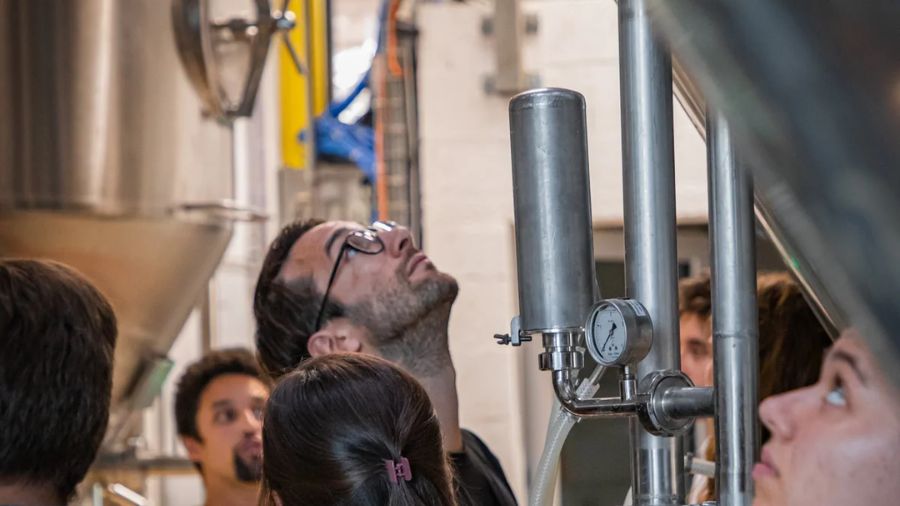
Have you ever wondered if looking at stainless steel tanks would really change the way you drink an IPA? It's a legitimate question. Craft brewery tours are no longer a niche thing: more and more Romand breweries are opening their doors, and curious visitors are showing up. But will you, personally, get anything concrete out of it?
Beginner or informed amateur, you won't get the same thing out of it
This is the point no one mentions: a craft brewery tour doesn't offer the same experience depending on your level. And that's normal.
If you know your IPAs from your Lagers without going much further, you'll leave with a framework. You'll finally understand why your Pale Ale is cloudy, what hops really bring, and how fermentation transforms sweet juice into beer. This framework changes how you read labels, how you choose at the bar, and your ability to put words to what you taste.
The informed amateur, on the other hand, is looking for something else. They want direct contact with the brewer, the technical choices behind a recipe, the reasons why one yeast was preferred over another. It's in these informal exchanges, in front of the tanks, that the nuances are revealed.
What neither will get in 1.5 hours: becoming an expert. Let's debunk that myth right away. A visit is a doorway, not a diploma. But it's a door that neither a book nor a YouTube video can replace, because it engages all five of your senses at once.
Moreover, it's precisely this sensory dimension that distinguishes a brewery visit from a simple stop at a bar. We don't consume, we understand. The tasting isn't an excuse: it connects what we've just seen to what we're drinking.
From malt to glass, what your senses perceive and your palate will remember
Specifically, a visit follows the journey of the beer. From crushing the grains to bottling, passing through mashing, hopping, and fermentation. Each step becomes tangible when you see the tanks, touch the malts, and smell the fresh hops.
Smell changes everything. In production, aromas are amplified. At La Nébuleuse, when you enter the brewhouse in Renens, the smell of hot malt and wet grains fills the space. You plunge your hand into a bin of crushed malt, rub hop cones between your fingers, and suddenly, what you read on labels comes to life.
But the real "aha!" moment, the one classic articles don't mention, is when you taste the wort before fermentation. This sweet, almost syrupy liquid, which tastes nothing like beer. That's when you physically understand the role of yeast: it transforms this flat juice into something living, gaseous, complex. It's impossible to grasp this difference between the wort and the finished beer without having experienced it. After that, you'll never look at a "refermented in bottle" label the same way again.
You also start to recognize notes in your glass that you smelled without identifying them: citrus from Citra hops, caramel from roasted malt, fruity esters from the yeast. It's this combination (sight, smell, taste, mouthfeel) that anchors knowledge much better than a descriptive sheet.
The guided tasting that concludes the visit is not anecdotal. It's when the puzzle comes together. The brewer lets you taste four to eight beers, explaining the choices for each recipe. At La Nébuleuse, the free tours include a tasting of four beers from their range, the perfect opportunity to understand the differences between craft beer styles, glass in hand. The format is designed so that each sip recalls a step you've just seen.
For those who want to go further, some breweries offer participatory brewing workshops where you literally get your hands in the malt. A more immersive, longer, and often more expensive format, but one that takes learning up a notch.
The brewer guide makes all the difference
You can have the most beautiful tanks in the world: if the guide recites a memorized text, the visit falls flat. This is the number one factor for satisfaction, by far.
A good guide is someone who brews. Who adapts their speech according to the group's questions. Who explains why they chose a local hop rather than an American import. Conversely, a "showcase" visit where you look at machines behind glass without direct interaction isn't really a craft brewery visit. It's disguised industrial tourism.
The warning sign: no access to production areas, no contact with someone who brews, a group of 40 people. If you tick these three boxes, you'll leave disappointed. Small group or private tour formats allow for real exchange, technical questions, and often anecdotes that aren't told in front of an amphitheater.
Craft breweries cultivate a spirit of community that comes directly through the quality of this human exchange. That's what distinguishes them from big brands, and that's what you're looking for.
What to check before booking
Three questions to ask before clicking "book":
- Access to production areas? If the visit is limited to a presentation room, move on.
- Guided tasting or self-service? The difference is huge. A guided tasting by the brewer is ten times better than a tray placed on a table.
- Group size? Less than 15 people is ideal for asking your questions.
In French-speaking Switzerland, good news: some breweries even offer free visits. At La Nébuleuse, in Renens, visits are open on Thursday, Friday evenings, and Saturday afternoons, with a tasting of four beers included, without spending a cent. Paid group formulas also exist for team outings or bachelor parties.
A craft brewery tour is worthwhile if you know what you're looking for: understanding the process, having a sensory experience, exchanging with someone who brews. The decor matters less than the guide.
The Romand offer is mature enough for you to find a formula adapted to your level, sometimes without even opening your wallet. And if you fall in love with a beer during the tasting, you can always find it on the La Nébuleuse e-shop to taste it again at home. For your next event, check out the keg dispenser rental.
Cheers! 🍻


