

A pricier craft beer, where does the money go?
You have a craft bottle in one hand, a supermarket lager in the other. The price of the first is double, sometimes triple. And you hesitate. It's a perfectly legitimate hesitation; nobody likes to pay more without knowing why.
The problem is that articles comparing craft and industrial beer discuss the process, ingredients, and taste, but almost never the bill. They tell you it's better, but rarely where your money goes.
If you're wondering why craft beer is more expensive, we'll break down the costs of a brew, item by item. You'll see that the price difference isn't due to posturing but to a series of production choices that are clear as day.
Ingredients Weigh Less Than You Think
The first reaction is to assume we're paying for better ingredients. A nobler hop, a finer malt, necessarily more expensive than the corn or rice an industrial brewer puts in their tanks. It's true that a craft brewer carefully selects their raw materials. But in the actual cost of a brew, they weigh much less than you imagine.
According to a detailed cost breakdown by a brewery cost tracking tool, raw materials represent only about one-fifth of the total cost of a batch. Grain, hops, yeast: add all that up, and you're far from half the bill. This is where the difference between craft and industrial beer plays out elsewhere than on the price of a bag of malt.
However, there's a nuance that matters. Some heavily hopped styles absorb part of the wort into the hops themselves. A NEIPA, that cloudy, juicy IPA, can lose a significant portion of its brew this way: less final volume for the same amount of work, hence a mechanically higher cost per liter.
This is exactly what the word "selected" means in practice. When we document our dry hopping work, which is the addition of cold hops after fermentation to extract aromas, we're talking about actions that cost hops and yield, not just an ingredient listed on a label.
Aging Time Ties Up Tanks and Cash Flow
This is an item nobody talks about. A beer that stays in the tank or keg for weeks, sometimes months, occupies production capacity that isn't running. Every day a tank is tied up by an aging beer, it's a tank that can't produce anything else. That time costs money.
A standard industrial lager is ready in a few days, on dedicated lines that never stop. A barrel-aged beer, however, ties up capital and space for months. The slowest processes, such as spontaneous fermentation, are so complex to master that the beers produced this way remain rare, therefore more expensive.
And this effect hits a small structure much harder. An industrial producer making huge volumes continuously can easily absorb an aging line. A Swiss craft brewery dedicating a tank to a long-aged beer loses a proportionally much larger part of its capacity.
Our Estafette, a Belgian tripel that improves with time thanks to its re-fermentation, perfectly illustrates this type of beer that requires patience before it reaches your glass. This patience is dormant cash flow, and it ends up in the price.
The Real Cost Driver
If ingredients are only one-fifth of the cost and aging ties up capital, where does the rest of your money go? Into two items that are systematically overlooked when talking about craft beer and high prices: packaging and labor. Together, they often weigh more than all the grain and hops combined.
Packaging, Often the Heaviest Item
The glass bottle, the label, the cardboard: each container has a fixed cost that doesn't change, whether you fill 500 bottles or 500,000. According to a cost breakdown published by the Huffington Post, packaging can represent the largest expense of a brew, even before ingredients. Not the grain, the packaging.
An industrial brewer negotiates their cans and cartons by the millions, which crushes the unit price. A craft brewery pays much more for the exact same container because it orders infinitely less. The glass that protects your beer from light, essential to avoid UV-related defects, therefore costs structurally more on a small scale.
Labor Isn't Diluted Over Millions of Liters
A brew requires roughly the same number of labor hours, whether it produces 500 liters or 5000. Monitoring, temperature adjustments, manual quality control: all this human time exists regardless of the volume in the tank.
For a small batch, it represents a huge part of the final price. On an automated industrial line that churns out millions of liters, it's diluted to the point of being almost invisible.
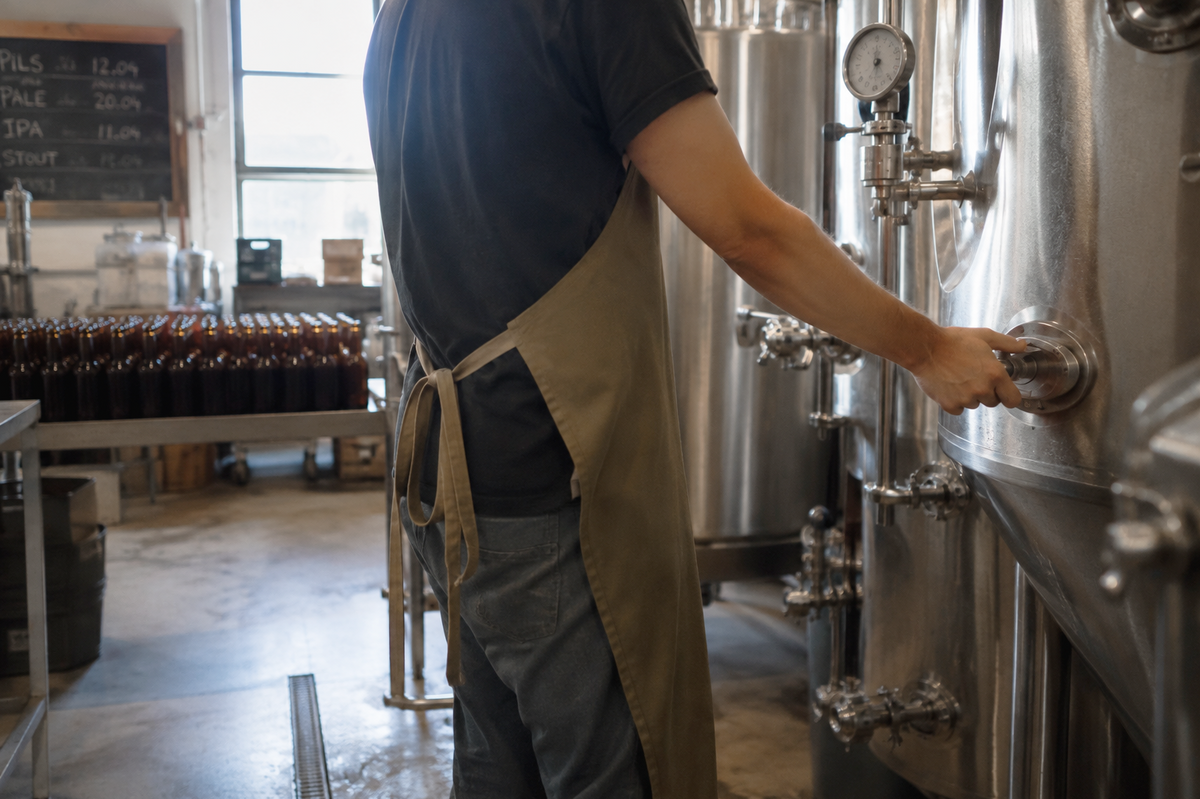
This is where the short supply chain makes perfect sense. At La Nébuleuse, we brew, bottle, and ship from a single site in Renens, in Greater Lausanne. Concretely, this means that the same person can taste the wort, adjust a temperature during fermentation, and check a beer during bottling on the same day.
When a tank is tied up to let an Estafette take its time, it's a conscious decision made here, not a production line we're subjected to. This labor remains entirely in-house, never outsourced elsewhere to save a few cents.
Every step, from grain to glass, is done by a team that follows the beer from start to finish. This isn't a cost line we're trying to cut; it's the heart of the trade.
What Swiss Taxation Really Changes
There's a common misconception to debunk. People sometimes imagine that the state drives up the price of craft beer, that taxes punish the small brewer. In Switzerland, the exact opposite is true.
The federal system structurally rewards small volumes. Independent breweries producing less than 55,000 hectoliters per year benefit from a tax reduction, graduated according to the quantity produced and potentially reaching 40%, according to the Federal Office for Customs and Border Security.
The maximum reduction applies to breweries under 16,000 hectoliters, and 96% of domestic breweries fall into this category. In other words, almost all Swiss craft brewers pay less tax per liter than an industrial giant.
So, if you're wondering why craft beer is more expensive despite this tax advantage, the answer is clear. The price difference doesn't come from punitive taxation; it comes from the production costs themselves: small volumes, aging time, undiluted labor, packaging paid at a high price. Taxation, on the other hand, favors the small producer.
Paying the Fair Price Rather Than Regretting a Random Choice
The price of a craft beer is a bill that breaks down item by item. Small volumes that don't allow for economies of scale, aging time that ties up tanks and cash flow, labor that is never diluted, packaging paid at a high rate, and all this before even talking about the quality of ingredients.
It's neither marketing nor posturing; it's a cost structure that holds up line by line.
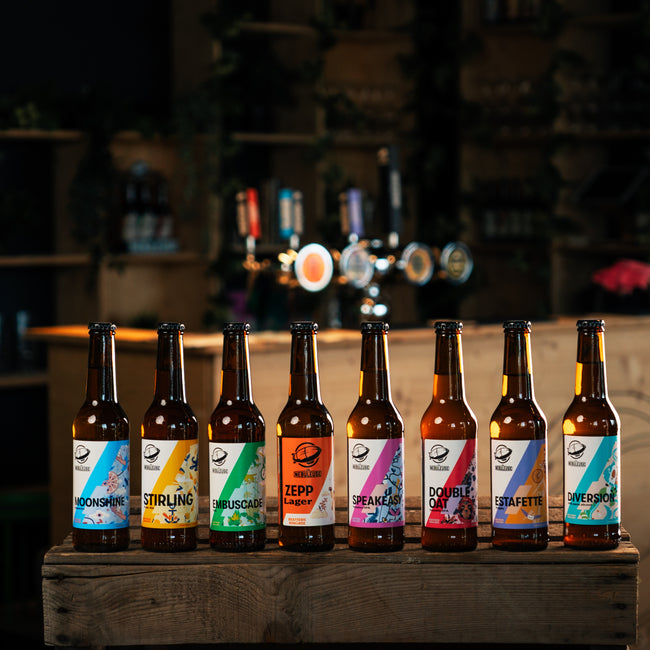
The real question that occupies you in the aisle remains: will you like it? The only way to know without taking a risk is to taste it. A discovery pack lets you explore several styles at once, from the Zepp' craft lager to the more hopped Embuscade, and if you don't drink alcohol, the alcohol-free Diversion range offers the same great taste.
Take a look at our complete collection of beers to get an idea, and if you have a question, write to us directly. Paying a little more for a beer that speaks to you is always better than regretting one chosen at random.
Cheers! 🍻


