

Stout and Porter are making a comeback on the Swiss craft scene
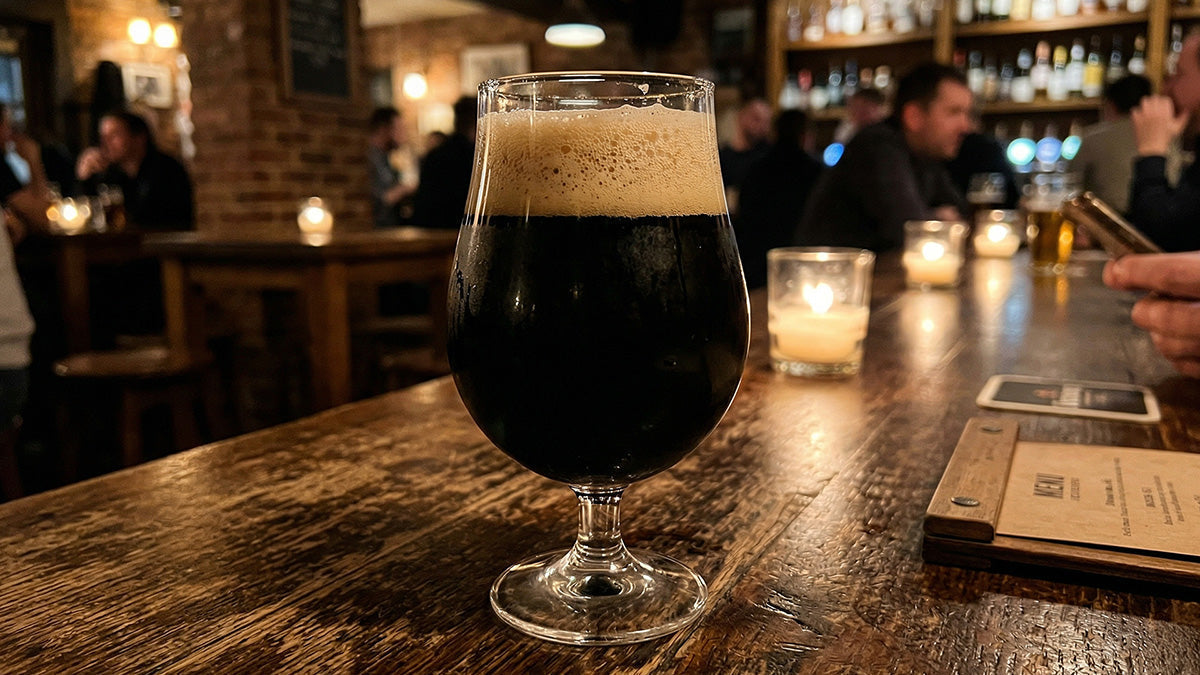
You've probably already turned down a dark beer after a Guinness served too cold in some pub. That's normal. Yet, the Stout and Porter segment shows global growth of 8.1% per year, driven by craft breweries and innovations that are changing everything. Dark beers are neither heavy nor austere. They were just waiting for a better context to win you over.
Stout was born from Porter with more character
It all begins in London, in the 18th century. Dockworkers unloading ships on the Thames drank a style of dark brown beer that eventually became known as "Porter," in their honor. The malt used at the time was called "Entire," and this style dominated England for almost a century.
As roasting techniques improved, brewers pushed the envelope. They created darker, more intense versions, which they called "Stout Porter," with "stout" meaning "strong" or "solid" in English. The word then became established on its own, carried by Irish brewers who exported it worldwide.
The technical difference lies in the malts. A Stout uses roasted unmalted barley, which gives it notes of black coffee and a frank bitterness, in an opaque robe. A Porter relies on roasted malts with sweeter flavors: toffee, caramel, molasses, with a dark brown color rather than absolute black.
Both share a common aromatic base: smoke, chocolate, coffee, caramel, sometimes vanilla. And in craft, the boundaries blur intentionally. As Espace Houblon aptly summarizes, a particular stout can resemble a porter depending on the brewer's approach. In practice, remember this: if you like coffee-dark chocolate aromas, go for a Stout. If you prefer caramel and molasses notes, Porter is your ally.
This market will be worth $14 billion in 2028
The comeback of dark beers is not just an impression. The global Stout and Porter market was estimated at $10.45 billion in 2024, with a projection to $14.26 billion by 2028. Europe dominates this segment, and independent craft breweries maintain a stable share with slight growth.
Two innovations explain this dynamic. The first is nitro technology: a double nitrogen dosage that replicates the creamy texture of a draft Stout, directly in a can. No need for a specialized bar to find that dense, silky foam.
The second is "dessert beers". Coffee Stout, Salted Caramel Porter, Chocolate-Mint Stout: these craft variations make dark beers accessible far beyond confirmed enthusiasts. They appeal to the curious who seek complex flavors without the frontal bitterness of a classic Dry Stout.
Swiss craft shines at the World Beer Awards
Switzerland hasn't always been a craft beer paradise. In 1990, the country had 32 breweries. By the end of 2019: 1,132. This explosion followed the dissolution of the brewing cartel in 1991, which had locked down the market for decades. The result: Switzerland became the world champion in terms of breweries per capita.
This density produces excellence. The Swiss brewing scene has distinguished itself several times at the World Beer Awards, particularly in the dark beer categories, a sign that creativity around dark styles extends across the entire country.
While German-speaking Switzerland excels internationally, French-speaking Switzerland builds its own artisanal dark beers with its unique terroir and identity. The ground is there, and so are the brewers.
At 14°C with dark chocolate, your Stout reveals everything
Your past bad experience with a dark beer probably has a simple explanation: temperature. A Stout served between 6 and 8°C crushes its aromas. Too warm, it becomes pasty. 14°C is the balance point where the aromatic palette truly unfolds.
At La Nébuleuse, our brewers are looking for exactly that in our dark beers: a balance between roasted malts that bring the coffee-chocolate side and a roundness on the palate that avoids any dryness. The choice of roasting temperature and the proportion of unmalted barley is what makes the difference between a dark beer that overwhelms you and one that invites you to the second sip.
Three pairings transform the experience. Dark chocolate creates a mirror effect with the roasted notes, almost obvious as the aromas echo each other. Blue cheeses (a good Bleu d'Auvergne or a Roquefort) bring a salty-creamy contrast that amplifies the beer's roundness. And grilled meats, BBQ style, play on the common smoky register.

Regarding the Romand terroir, Swiss chocolate and regional AOC cheeses (aged Gruyère, Vacherin fribourgeois) are natural partners that generic tasting guides completely ignore. Yet, that's where Swiss craft dark beer truly comes into its own. And if you're planning a BBQ or a tasting evening with friends, consider renting a dispenser to serve your Stout in style.
What to avoid: oily fish, very acidic dishes, and fresh goat cheeses. Acidity neutralizes roasted aromas instead of complementing them. And if you're new to dark beers, start with a caramel-noted Porter before moving on to a more assertive coffee Stout.
Porter and Stout share the same lineage but offer distinct profiles that change everything during tasting. Their comeback is global, quantified, and driven by a Swiss craft scene that is among the densest in the world. All that remains is for you to explore these styles yourself: browse our dark beer encyclopedia to discover our Stouts and Porters, book a brewery visit to taste them at the source, or order a keg for your next event.
Cheers! 🍻


