

Renting a beer tap: your stress-free guide for the big day
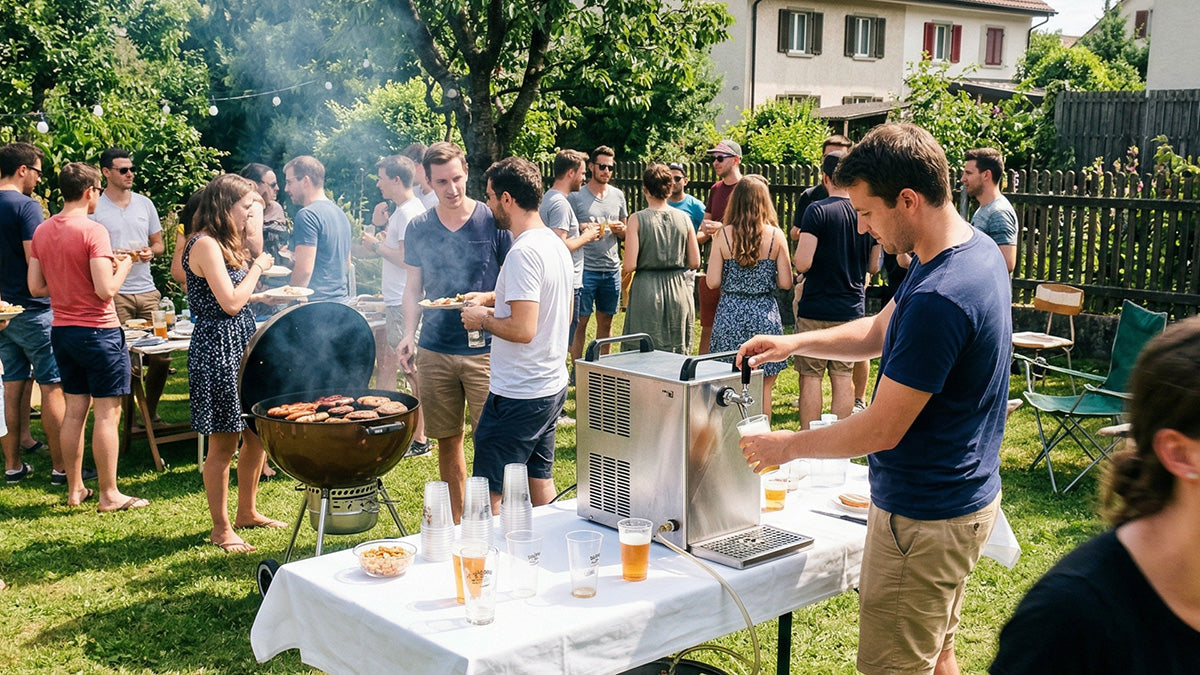
You're hosting a BBQ for 30 friends, you pick up a beer dispenser the day before, you tap the keg on the big day, and with the very first glass: foam. Nothing but foam. By the time you figure out what's wrong, you've already lost two liters and the mood takes a hit.
This scenario happens more often than you think. Before booking a beer tap rental for your event, four factors make all the difference between a smooth evening and a wasted keg: the quantity ordered, the type of dispenser, the settings for your beer, and the pouring technique.
Calculating liters is simpler than it seems
First classic mistake: ordering "by feel." Too little and you run dry by the end of the evening, too much and you throw it away. Two figures are enough to get it right.
Firstly, not everyone drinks beer. Data from La Voie Maltée estimates that 70 to 75% of adult guests actually consume it. Secondly, each beer drinker consumes approximately 1 to 1.5 liters over four hours of celebration. The rest of the calculation is straightforward.
Concretely, a 20L keg fills about 80 25cl glasses and covers 15 to 20 people. Here are a few examples to give you an idea:
- BBQ for 20 friends: 1 x 20L keg is more than enough
- Wedding with 60 guests (~45 drinkers): 2 to 3 x 20L kegs
- Professional after-work event for 100 people: 4 to 6 x 20L kegs, with an appropriate serving rate
It's always better to round up slightly. An opened keg only keeps for 24 to 48 hours after opening (depending on storage conditions), but a shortage during an aperitif cannot be remedied.
The type of dispenser depends on the context, not the budget
We often choose the cheapest dispenser. Bad reflex. It's the number of guests and the location (indoor or outdoor) that dictate the right model.
For an intimate gathering of less than 10 people, a compact PerfectDraft 6L model does the job, or get custom packs. Simple, without a CO2 bottle, just plug it in and you're good to go. For more than 20 guests, a professional 1-tap dispenser connected to a 20L keg becomes essential to maintain a decent flow rate.
For 50 people or more, or outdoors in the sun, you need an integrated cooling dispenser (known as an "ice-bank"). The system circulates the beer through a coil immersed in an ice bath to keep it at temperature despite the heat, but it requires 6 hours of pre-cooling and a nearby power outlet.
Flow rate is often overlooked: 30 to 50 liters per hour is sufficient for a family gathering, but a professional or association event requires 60 liters/hour or more to avoid queues during peak service times.
A point rarely mentioned in guides: also consider access logistics. A professional dispenser with its keg weighs about 40 kg when loaded. If your event is on the third floor without an elevator or in a field 200 meters from the parking lot, that changes the choice of model.
An IPA is not poured like a Wheat Beer
With an industrial beer, the setting is standard. With a craft beer, it's a different story. Craft kegs are mainly 20L stainless steel returnable kegs, with specific connectors that don't fit all dispensers. First reflex: check compatibility with your provider.
The beer style also matters. The CO2 in the dispenser doesn't carbonate the beer (it's already carbonated in the keg), it pushes it towards the tap nozzle. The reference pressure is around 2 to 2.2 bars at 20°C, but it adjusts according to the beer's profile.
A heavily hopped IPA is very sensitive to heat and foams easily. If you serve it outdoors in summer, the cooler is not optional, it's mandatory. A Session Lager or a Wheat Beer tolerates temperature variations better, making them safer choices for summer service. You can find detailed profiles of each style in La Nébuleuse beer encyclopedia.
Another subtlety few guides mention: a heavily hopped beer (IPA, NEIPA) loses its aromas faster once the keg is opened. If your event lasts two days, it's better to reserve the IPA keg for the day of high attendance and keep a Lager or Wheat Beer (more stable) for the next day.
The advantage of going through an artisanal brewery: they know their beers and adjust the pressure for you.
Three mistakes that turn your beer into foam
Excessive foam almost always comes from the same causes. Three mistakes to know so you don't repeat them. And if you want to see everything in pictures, consult the La Nébuleuse dispenser usage tutorials.
The keg is not cold enough. The dispenser must be turned on several hours before the first service. Store your kegs below 12°C, and if you use an ice-bank dispenser, plug it in at least 6 hours in advance. Otherwise, the beer comes out warm and foams instantly.
The pressure is poorly adjusted. Too much pressure and you get a glass of foam. Not enough and the beer flows slowly. The reference: 2 to 2.2 bars at 20°C ambient, with +0.1 bar per meter of elevation difference between the keg and the tap.
The pouring technique is approximate. Glass tilted at 45°, tap opened sharply, not gradually. Poor technique causes a loss of about 1 liter per keg in excess foam. Multiplied by several kegs over an evening, that adds up quickly.
Why choose a local brewery rather than a rental company
A general rental company provides you with equipment. An artisanal brewery provides you with the equipment, the beer, the adapted settings, and the advice that prevents problems. Many also offer the free loan of the dispenser in exchange for purchasing the kegs, which often makes the operation more economical than a classic rental.
The other advantage is guaranteed compatibility: no unpleasant surprises with an incompatible connector, no foamy beer due to inappropriate settings. The setup and pressure are calibrated beforehand, even before you pick up the equipment.
If you want to try this model, La Nébuleuse offers a mobile dispenser or a vintage Piaggio bar with the 20L kegs from the range, a turnkey setup. And for guests who prefer to serve themselves, the e-shop delivers from CHF 100 of purchase.
Your next party deserves better than warm foam in plastic cups. Cheers! 🍻


