

How does an experimental brew become a production beer?

Behind every new beer you discover at the bar or in a can, there are dozens of brews that never left the brewhouse. Scribbled recipes, failed attempts, adjustments down to the half-degree. The path from an idea to a beer available on the shelf is a real technical obstacle course, and it's precisely this journey that guarantees the quality of what ends up in your glass.
Why breweries are investing in a pilot system
Testing a recipe directly on a production tank of several thousand liters is a risky gamble. If the result is disappointing, hundreds of liters of beer (and thousands of francs worth of raw materials) go down the drain. At Summit Brewing, a brewery in Minnesota, the situation was clear before installing their pilot system: "We ended up throwing away a lot of beer when we tried new recipes on a production scale."
This is why almost all serious craft breweries now have a pilot system , a miniature brewing setup (usually between 50 and 200 liters) that replicates real-world production conditions. At Allagash Brewing in the United States, 112 pilot beer ideas were brewed in a single year, and any employee can submit a recipe. The idea is simple: multiply small-scale trials and only bring the truly successful recipes into full production.
La Nébuleuse is well acquainted with this logic. The adventure began in 2010 with a 60-liter tank in a kitchen, long before the brewery reached its current capacity of 3 million liters per year. Even at this scale, experimental brewing remains a daily tool for innovation.
The three stages of an experimental brew
It all starts with a target profile on paper
Even before lighting the brewing kettle, the brewer precisely defines what they are looking for: what style? What balance between bitterness and aromas? What final gravity? This initial specification sets the fermentation parameters , the choice of malts, hops, and yeast. It's a formulation process where the brewer's experience and knowledge of raw materials make all the difference.
The IFBM , the leading brewing and malting institute based in France, structures this process by starting with a 100-litre microbrewery, ideal for "experimenting and perfecting the initial formula in small quantities, ensuring precision and control from the start".
The pilot brew puts the theory to the test
Next comes the transfer to the tank. On a pilot system, each parameter is measured and recorded: mashing temperatures, boiling time, wort density, pH . This precise instrumentation makes it possible to understand exactly what is happening in the tank and, above all, to reproduce the result or adjust it.
A pilot batch takes the same amount of time as a production batch (a full day for brewing, then two to four weeks of fermentation depending on the style), but on a smaller volume that limits the risk. If the result doesn't match the target profile, adjustments are made and the process is repeated, sometimes three or four times before the right balance is found.
Sensory evaluation decides
The final step before any decision to put the beer into production is the tasting. Not just a simple sip from the brewing tank: a panel of brewers and tasters evaluates the beer based on specific criteria (aromas, flavors, texture, aftertaste, appearance). This collective verdict determines whether the recipe goes into production, returns to the lab for adjustments, or is simply abandoned. To explore the unusual ingredients that fuel these experiments, you can read our article on experimental craft beers and their unconventional ingredients .
Scaling up is a challenge that simple multiplication cannot solve.
You might think that simply multiplying the quantities by twenty would solve the problem of going from a 100-liter batch to a 2000-liter tank. In reality, the physics of brewing changes with volume . As the experts at Brewer Magazine explain, "you can't just take a pilot recipe and multiply everything by twenty to get a production recipe."
The base malts roughly follow the ratio, but roasted malts develop more color on a large scale, and their proportion must be reduced (by a factor of 17 instead of 20). With hops, it's the opposite: sometimes 50% more hops are needed than a simple proportional calculation would indicate. The reason lies in the geometry of the tanks. A 40-barrel pilot tank has one-twentieth the volume of an 800-barrel tank, but only one-seventh of its surface area. This difference in surface area to volume ratio alters heat transfer, hydrostatic pressure, and fermentation behavior.
In practice, each new recipe that goes into production requires a few adjustment batches to "calibrate" the result to the main system. It's an iterative process where the brewer fine-tunes the parameters until the production tank achieves the exact profile that was validated in the pilot batch.
What experimental brews bring to your glass
This often invisible, groundwork is what distinguishes an innovative brewery from one that simply reproduces the same recipes. Limited editions, seasonal beers, collaborations between brewers: everything begins with the pilot phase. In a Swiss market that now boasts over 1,100 breweries for 8.8 million inhabitants (a world record density), this capacity for innovation makes all the difference.
For you, the consumer, it means one simple thing: every beer you taste has been conceived, tested, and approved before reaching your glass. The pilot system is the safety net that ensures only the best recipes go into production.
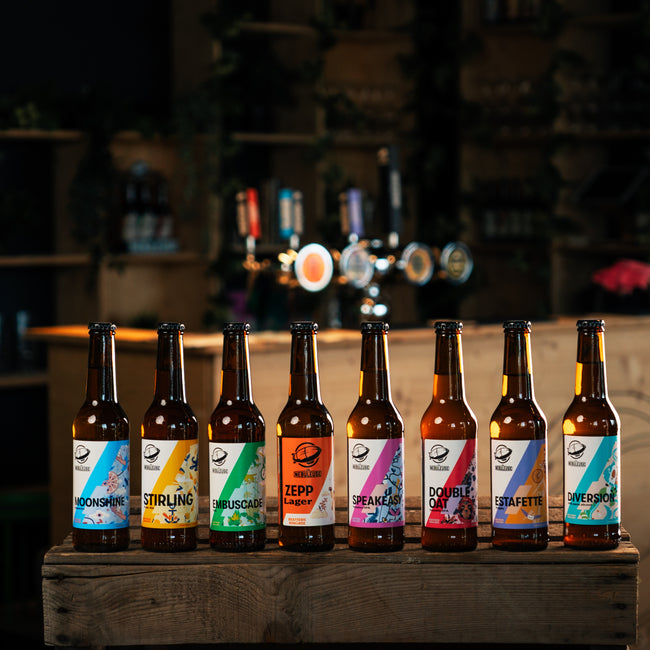
If you want to see what this process looks like from the inside, a visit to our brewery in Renens takes you behind the scenes, from the brewhouse to the fermentation tanks. And to taste the results of our latest experiments, our full range is available online with free delivery on orders over CHF 100.
Cheers! 🍻


